Catching Up On Google

on Tuesday, November 16, 2010

h.264 dvr

Latest search engine user statistics from Chitika, a respected search marketing and ad click specialist, shows that Bing has grabbed the second market share position, leapfrogging Yahoo.
The research shows the improvement in Microsoft’s increasingly well received search engine facility, Bing, which is being perceived as a relative success in the way it targets both consumers and advertisers away from Google.
The research data shows that Bing took over the second place rankings as early as January this year.
The latest figures show that while Google remains top dog, the Microsoft and also Yahoo combination of Bing and Yahoo continues to erode Google’s dominance in search.
Yahoo’s market share rose 1.22 per cent from June this year, ending at 6.14 per cent of all traffic sent into the Chitika network, while Bing’s share declined 0.7 per cent but remained significantly high at 10.56 per cent – an impressive figure seeing as Bing only launched last year.
Google lost just over half a per cent in the same period, posting a July market share of 80.97 per cent.
AOL and Aim continue to jostle for the fourth place position with 1.22 per cent and 1.12 per cent of the search market share, respectively.
Software market leader Microsoft announced in 2009 that it was re-launching its online search portal with a new name and a new look.
In an attempt to take on Google, Bing went live in June 2009 with the claim of offering quicker and more refined searches. The search engine quickly received praise for its use of high definition colour images on its home page, often attractive landscapes; as well as its ease of use.
Chitika research also shows that Bing may have a smaller portion of the available audience for search engine marketing revenue than Google but according to a new study from its users are more likely to click on ads – a critical part of the Pay Per Click (PPC) model.
Across a sample of 15 million impressions by web users used by Chitika, Bing users clicked on ads every 1.67 per cent of times they viewed the ads in search engine results. This was significantly higher than Google, whose click rate was just 1.09 per cent.
Ask and AOL are also worth a mention in this regard, their services are most likely to see user click through – 2.92 per cent and 2.48 per cent respectively.
This is despite the majority of ComScore and HitWise reports over the last year showing that these search engines had less than 5 per cent of the search market share between them.
With regards Bing’s increasing market success, Chitika says this is because Microsoft did the right thing by targeting people who buy online.
Bing’s higher click rate is thought to be due to the search engine’s integration of e-commerce features early on, particularly its cash-back promotional advertising service, which successfully targeted consumers.
In terms of traffic increases and ad revenues it’s clearly all good news for Bing and a sign that Microsoft should not be underestimated in any market that it is competing in.
Places SEO Secret Uncovered.

Google Maps SEO Uncovered

Well folks, today you really are in for a treat. After much contemplation we have decided to give you our secret to high rankings in Google places (Google Local).

We have spent an entire year researching, testing and more testing to find out just what factors makes Google Local listings rank.
Forget what you already might know.

First of all let me point out, forget everything out there which you have seen on YouTube, blogs and news from “SEO gurus”. I hate to say it but it’s wrong. Seems one person has started off a theory, and millions of people have blogged on the same topic, slowly giving it more credibility then it’s worth.

The internet and its millions of ”SEO experts” tell you, Google local SEO works on the basis that you have to be listed in certain directories across the web. There is a strong belief that the if you submit to a select number of directories, you will eventually jump on the results. Having been trying to optimise the maps from day one, this theory just didn’t seem to make sense to us, given the fact we had number 1 positions on popular key terms, without a single directory listing.

I hate reading blogs online, where someone gives you their top 5 tips on SEO , but in reality you get nothing substantial at the end of the article, just the same methods wrote differently. We know who these guys are ;-)
Google Maps Re Visited

Now back last year, the easiest way to push a position on Google local was to simply ensure that the titles of the business name were keyword rich and by playing around with the category section was enough to give you a decent push, these days are gone. This isn’t a bad thing, as it’s removed all the spammers keyword stuffing.

So now below, I will give you the best advice you will ever receive about Google maps, no catches.
1. Rule number 1.

Remove all duplicated listings. This is crucial if you want any of the below to work. You MUST search via your phone number, for existing listings already out there. Input your business name and then try phone number, until you are 100% there are no duplicate or old listings out there.

2. Have a Clean out.

Now time to search and destroy duplicate listings, but be careful which you delete and which you keep.
You basically don’t want to delete the listing which holds the most authority. We can gauge this by checking to see if the existing listing already has “key information” i.e. maps, comments, external site reviews, pointing to it. The more information held, the more authority it holds. Always delete the skinny one with the least amount of information attached.
See below circled in red where the “key information” is held.


Only once you are confident there are no more duplicate listings out there, you may proceed to the next step.

By now you should have 1 listing and hopefully the one which holds all the authority. If you’re creating a listing for the first time, Google may have previously created a map for you, so check double check and check again.
3. Basic Housekeeping

By now you should have setup your listing. Remember to always add a photo and fill out the category with your top keywords. DO NOT add in a location with the keyword in the category section, with the hope this helping you.

Example: “Doctor Edinburgh” in the category section. This used to work, but not anymore.

Don’t worry about going OTT and adding 100 pictures and videos, this isn’t going to be a make or break point.

TIP (naughty book)
When your verify your number with Google, if it doesn’t give you the option to send a text or call to verify, this is not a good sign. If you’re getting an option to send a postcard only, this means your number is in the naughty book.
I’ve had to learn this the hard way, but once your numbers in the naughty book, it’s virtually impossible to recover. You will simply have to try another number. This can also be an indication you have a duplicate listing lurking in the depths of Google Places.

By now you should have a perfect listing. You may already have noticed your listing shot up, this can work instantly if there was a duplicate listing previously out there.

Note: You can almost see maps update real-time by viewing your listing on the “maps” section first. Check .co.uk results first and it will be a clear indication of where you will rank on the main page.
Google maps updates almost instantly (not always) , you will find later the exact results are mirrored on the main search page.

4. Now for the killer tip.

You need a Google account for this. And I recommend you don’t abuse this , yet use it properly. The biggest factor in pushing a Google local listing up is, MY MAPS . Some may have noticed it, others maybe not. These maps are diamonds.

The trick is to create a map and optimise the titles. I will give you a demonstration.

* Step 1. Go to Google Maps. (whilst signed in)
* Step 2. Click on My Maps
* Step 3. Click on lets get started and you should see

As you can see I am trying to optimise for Goldsmiths London. Drop in some useful content about what the map shows and save. Remember not to over spam this, keep it clean.


* Step 4

Once your map is made, it’s now time to go find businesses and places to add to it. First step is to add your own listing!
Search for your business on the maps section , for this example I will search Georg Jensen Ltd who is our “goldsmith in London”
Click on the listing and you will see

Now save the listing to the correct map and your done!

Now this won’t work instantly, but over the next few weeks Google will crawl this map. Once its crawled it will attach to your local listing. Soon as this is done, prepare to see your listing rocket up.

Tip:

Try and make your maps interesting, vary the different types of businesses and places you show, (whilst adding in your own).

We hope you enjoy these tip. We will be slowly sharing more tips and tricks, so follow me on twitter www.twitter.com/ravindsandhu or follow our company www.twitter.com/bighitmediauk .

We look forward to your feedback. Good luck!

Google Top 10 Ranking Secret!

This summary is not available. Please click here to view the post.

Company Overview

on Thursday, July 30, 2009

Google's mission is to organize the world's information and make it universally accessible and useful.

As a first step to fulfilling that mission, Google's founders Larry Page and Sergey Brin developed a new approach to online search that took root in a Stanford University dorm room and quickly spread to information seekers around the globe. Google is now widely recognized as the world's largest search engine -- an easy-to-use free service that usually returns relevant results in a fraction of a second.

When you visit www.google.com or one of the dozens of other Google domains, you'll be able to find information in many different languages; check stock quotes, maps, and news headlines; lookup phonebook listings for every city in the United States; search billions of images and peruse the world's largest archive of Usenet messages -- more than 1 billion posts dating back to 1981.

We also provide ways to access all this information without making a special trip to the Google homepage. The Google Toolbar enables you to conduct a Google search from anywhere on the web. And for those times when you're away from your PC altogether, Google can be used from a number of wireless platforms including WAP and i-mode phones.

Google's utility and ease of use have made it one of the world's best known brands almost entirely through word of mouth from satisfied users. As a business, Google generates revenue by providing advertisers with the opportunity to deliver measurable, cost-effective online advertising that is relevant to the information displayed on any given page. This makes the advertising useful to you as well as to the advertiser placing it. We believe you should know when someone has paid to put a message in front of you, so we always distinguish ads from the search results or other content on a page. We don't sell placement in the search results themselves, or allow people to pay for a higher ranking there.

Thousands of advertisers use our Google AdWords program to promote their products and services on the web with targeted advertising, and we believe AdWords is the largest program of its kind. In addition, thousands of web site managers take advantage of our Google AdSense program to deliver ads relevant to the content on their sites, improving their ability to generate revenue and enhancing the experience for their users.

To learn more about Google, click on the link at the left for the area that most interests you. Or type what you want to find into our search box and hit enter.

What's a Google?

"Googol" is the mathematical term for a 1 followed by 100 zeros. The term was coined by Milton Sirotta, nephew of American mathematician Edward Kasner, and was popularized in the book, "Mathematics and the Imagination" by Kasner and James Newman. Google's play on the term reflects the company's mission to organize the immense amount of information available on the web.

Life of a Google Query

Life of a Google Query


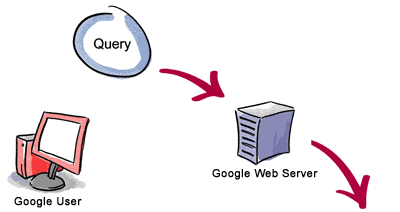
The life span of a Google query normally lasts less than half a second, yet involves a number of different steps that must be completed before results can be delivered to a person seeking information.


3.
The search results are returned to the user in a fraction of a second.
1. The web server sends the query to the index servers. The content inside the index servers is similar to the index in the back of a book - it tells which pages contain the words that match the query.
2.The query travels to the doc servers, which actually retrieve the stored documents. Snippets are generated to describe each search result.

Technology Overview

We stand alone in our focus on developing the "perfect search engine," defined by co-founder Larry Page as something that, "understands exactly what you mean and gives you back exactly what you want." To that end, we have persistently pursued innovation and refused to accept the limitations of existing models. As a result, we developed our serving infrastructure and breakthrough PageRank™ technology that changed the way searches are conducted.

From the beginning, our developers recognized that providing the fastest, most accurate results required a new kind of server setup. Whereas most search engines ran off a handful of large servers that often slowed under peak loads, ours employed linked PCs to quickly find each query's answer. The innovation paid off in faster response times, greater scalability and lower costs. It's an idea that others have since copied, while we have continued to refine our back-end technology to make it even more efficient.

The software behind our search technology conducts a series of simultaneous calculations requiring only a fraction of a second. Traditional search engines rely heavily on how often a word appears on a web page. We use more than 200 signals, including our patented PageRank™ algorithm, to examine the entire link structure of the web and determine which pages are most important. We then conduct hypertext-matching analysis to determine which pages are relevant to the specific search being conducted. By combining overall importance and query-specific relevance, we're able to put the most relevant and reliable results first.

  • PageRank Technology: PageRank reflects our view of the importance of web pages by considering more than 500 million variables and 2 billion terms. Pages that we believe are important pages receive a higher PageRank and are more likely to appear at the top of the search results.

    PageRank also considers the importance of each page that casts a vote, as votes from some pages are considered to have greater value, thus giving the linked page greater value. We have always taken a pragmatic approach to help improve search quality and create useful products, and our technology uses the collective intelligence of the web to determine a page's importance.

  • Hypertext-Matching Analysis: Our search engine also analyzes page content. However, instead of simply scanning for page-based text (which can be manipulated by site publishers through meta-tags), our technology analyzes the full content of a page and factors in fonts, subdivisions and the precise location of each word. We also analyze the content of neighboring web pages to ensure the results returned are the most relevant to a user's query.

Our innovations don't stop at the desktop. To give people access to the information they need, whenever and wherever they need it, we continue to develop new mobile applications and services that are more accessible and customizable. And we're partnering with industry-leading carriers and device manufacturers to deliver these innovative services globally. We're working with many of these industry leaders through the Open Handset Alliance to develop Android, the first complete, open, and free mobile platform, which will offer people a less expensive and better mobile experience.

The technology behind Google's great results

on Tuesday, July 28, 2009

As a Google user, you're familiar with the speed and accuracy of a Google search. How exactly does Google manage to find the right results for every query as quickly as it does? The heart of Google's search technology is PigeonRank™, a system for ranking web pages developed by Google founders Larry Page and Sergey Brin at Stanford University.

PigeonRank System


Building upon the breakthrough work of B. F. Skinner, Page and Brin reasoned that low cost pigeon clusters (PCs) could be used to compute the relative value of web pages faster than human editors or machine-based algorithms. And while Google has dozens of engineers working to improve every aspect of our service on a daily basis, PigeonRank continues to provide the basis for all of our web search tools.

Why Google's patented PigeonRank™ works so well

PigeonRank's success relies primarily on the superior trainability of the domestic pigeon (Columba livia) and its unique capacity to recognize objects regardless of spatial orientation. The common gray pigeon can easily distinguish among items displaying only the minutest differences, an ability that enables it to select relevant web sites from among thousands of similar pages.

By collecting flocks of pigeons in dense clusters, Google is able to process search queries at speeds superior to traditional search engines, which typically rely on birds of prey, brooding hens or slow-moving waterfowl to do their relevance rankings.

diagramWhen a search query is submitted to Google, it is routed to a data coop where monitors flash result pages at blazing speeds. When a relevant result is observed by one of the pigeons in the cluster, it strikes a rubber-coated steel bar with its beak, which assigns the page a PigeonRank value of one. For each peck, the PigeonRank increases. Those pages receiving the most pecks, are returned at the top of the user's results page with the other results displayed in pecking order.

Integrity

Google's pigeon-driven methods make tampering with our results extremely difficult. While some unscrupulous websites have tried to boost their ranking by including images on their pages of bread crumbs, bird seed and parrots posing seductively in resplendent plumage, Google's PigeonRank technology cannot be deceived by these techniques. A Google search is an easy, honest and objective way to find high-quality websites with information relevant to your search.

Data

PigeonRank Frequently Asked Questions

How was PigeonRank developed?

The ease of training pigeons was documented early in the annals of science and fully explored by noted psychologist B.F. Skinner, who demonstrated that with only minor incentives, pigeons could be trained to execute complex tasks such as playing ping pong, piloting bombs or revising the Abatements, Credits and Refunds section of the national tax code.

Brin and Page were the first to recognize that this adaptability could be harnessed through massively parallel pecking to solve complex problems, such as ordering large datasets or ordering pizza for large groups of engineers. Page and Brin experimented with numerous avian motivators before settling on a combination of linseed and flax (lin/ax) that not only offered superior performance, but could be gathered at no cost from nearby open space preserves. This open space lin/ax powers Google's operations to this day, and a visit to the data coop reveals pigeons happily pecking away at lin/ax kernels and seeds.

What are the challenges of operating so many pigeon clusters (PCs)?

Pigeons naturally operate in dense populations, as anyone holding a pack of peanuts in an urban plaza is aware. This compactability enables Google to pack enormous numbers of processors into small spaces, with rack after rack stacked up in our data coops. While this is optimal from the standpoint of space conservation and pigeon contentment, it does create issues during molting season, when large fans must be brought in to blow feathers out of the data coop. Removal of other pigeon byproducts was a greater challenge, until Page and Brin developed groundbreaking technology for converting poop to pixels, the tiny dots that make up a monitor's display. The clean white background of Google's home page is powered by this renewable process.

Aren't pigeons really stupid? How do they do this?

While no pigeon has actually been confirmed for a seat on the Supreme Court, pigeons are surprisingly adept at making instant judgments when confronted with difficult choices. This makes them suitable for any job requiring accurate and authoritative decision-making under pressure. Among the positions in which pigeons have served capably are replacement air traffic controllers, butterfly ballot counters and pro football referees during the "no-instant replay" years.

Where does Google get its pigeons? Some special breeding lab?

Google uses only low-cost, off-the-street pigeons for its clusters. Gathered from city parks and plazas by Google's pack of more than 50 Phds (Pigeon-harvesting dogs), the pigeons are given a quick orientation on web site relevance and assigned to an appropriate data coop.

Isn't it cruel to keep pigeons penned up in tiny data coops?

Google exceeds all international standards for the ethical treatment of its pigeon personnel. Not only are they given free range of the coop and its window ledges, special break rooms have been set up for their convenience. These rooms are stocked with an assortment of delectable seeds and grains and feature the finest in European statuary for roosting.

What's the future of pigeon computing?

Google continues to explore new applications for PigeonRank and affiliated technologies. One of the most promising projects in development involves harnessing millions of pigeons worldwide to work on complex scientific challenges. For the latest developments on Google's distributed cooing initiative, please consider signing up for our Google Friends newsletter.